Color marking & annealing, explained.
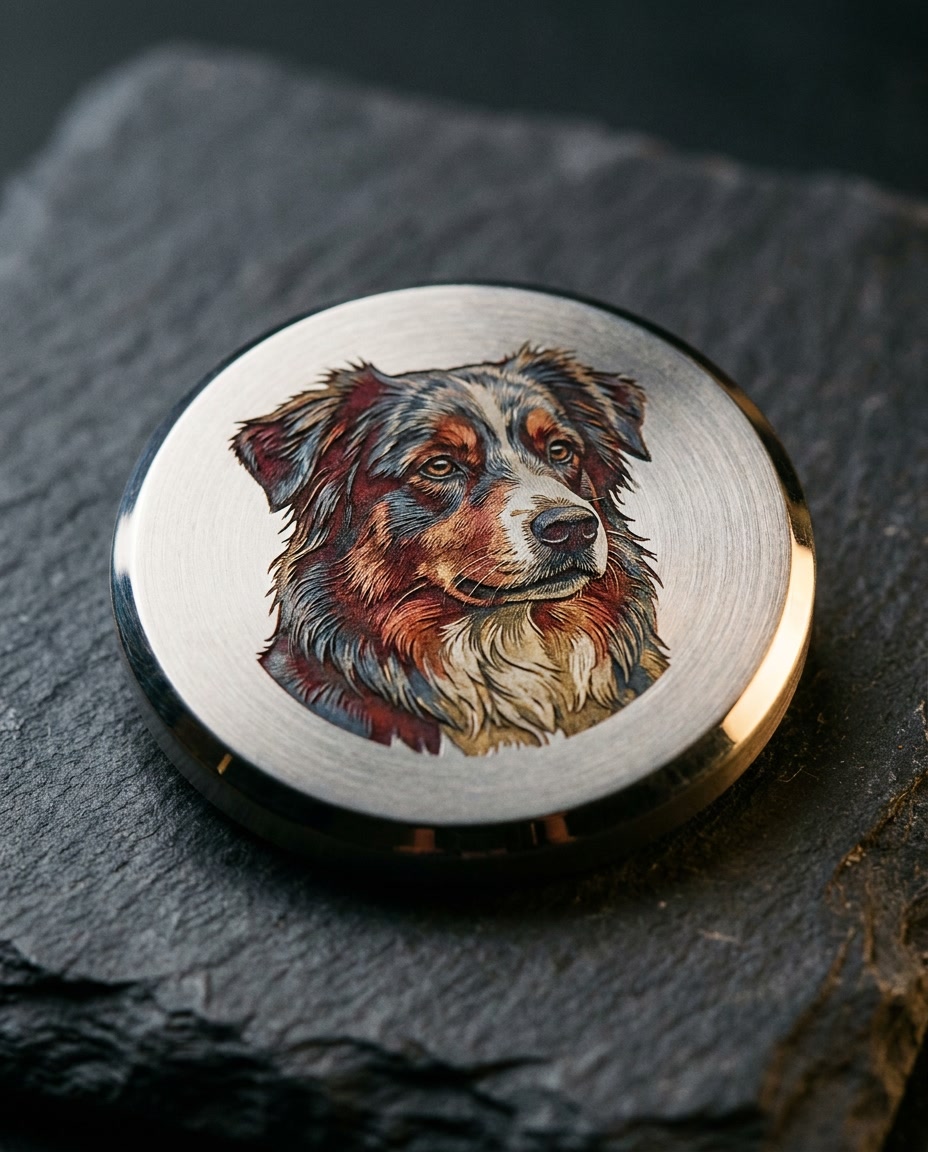
No ink, no paint — the color is the metal's own oxide.
A thin transparent oxide film forms on the heated metal; light reflecting off the film and off the metal beneath interfere to read as color — thicker film, different color, the same effect as a soap bubble or an oil slick. Because the film is grown rather than deposited, the color can't be scratched off like paint.
Annealing is the same process aimed at black instead of color: a slightly different oxide, flat and dark, sitting flush with the surface. Nothing is cut away, so the surface stays smooth, corrosion-resistant, and free of sharp edges — the reason annealing is standard for marine plates, medical instruments, and food-grade pieces.
Annealing vs. engraving — when to use which.
| Annealing / color | Deep engraving | |
|---|---|---|
| Material removed | None — surface oxide only | Yes — cuts a recess |
| Feel | Flush, smooth | Tactile, dimensional |
| Corrosion | Surface stays sealed — best outdoors | Removes the protective layer; seal or paint-fill |
| Color / fill | Interference color or black | Paint-fill for true, durable color |
| Best for | Marine, medical, awards, personalization | Plaques, heavy-wear pieces, deep contrast |
The honest limits of color.
Color marking is a genuine differentiator, but it isn't full-color printing — worth setting the expectation up front:
- It's a palette of hues, not Pantone matching. Expect a reliable range — golds, coppers, blues, purples, greens; typically around seven dependable hues on stainless once dialed in, and a wider range on titanium. It can't reproduce a photo in color or match an exact brand red.
- It's viewing-angle dependent. A blue plate can read purple at a steeper angle. That's the physics of interference, not a defect.
- It's finish- and alloy-sensitive. Brushed, mirror, and bead-blast surfaces color differently, and each alloy needs its own tuning — so every new piece starts with a short calibration.
- It's for display, not abrasion. Beautiful on mounted plaques, awards, and markers; not meant for surfaces that get scrubbed or walked on. For heavy wear, engrave and paint-fill.
Think of color marking as an artisanal, hand-tuned finish — not industrial color printing. For the full material-by-material breakdown, see laser engraving capabilities.
Quick answers.
Which metals color best?
Stainless and titanium — titanium gives the widest range. Anodized aluminum marks crisp white or true black.
Will the color chip?
It's oxide in the metal, so it won't chip or peel like paint — but the layer is thin, so it's for display, not scrubbing.
Anneal or engrave for marine?
Anneal. It keeps stainless's corrosion-resistant surface sealed. Deep engraving removes that layer — better paint-filled and indoors.
See it on your piece.
Share the metal and the look you're after for an assessment of what's achievable and a quote — free.