Laser vs. traditional engraving.
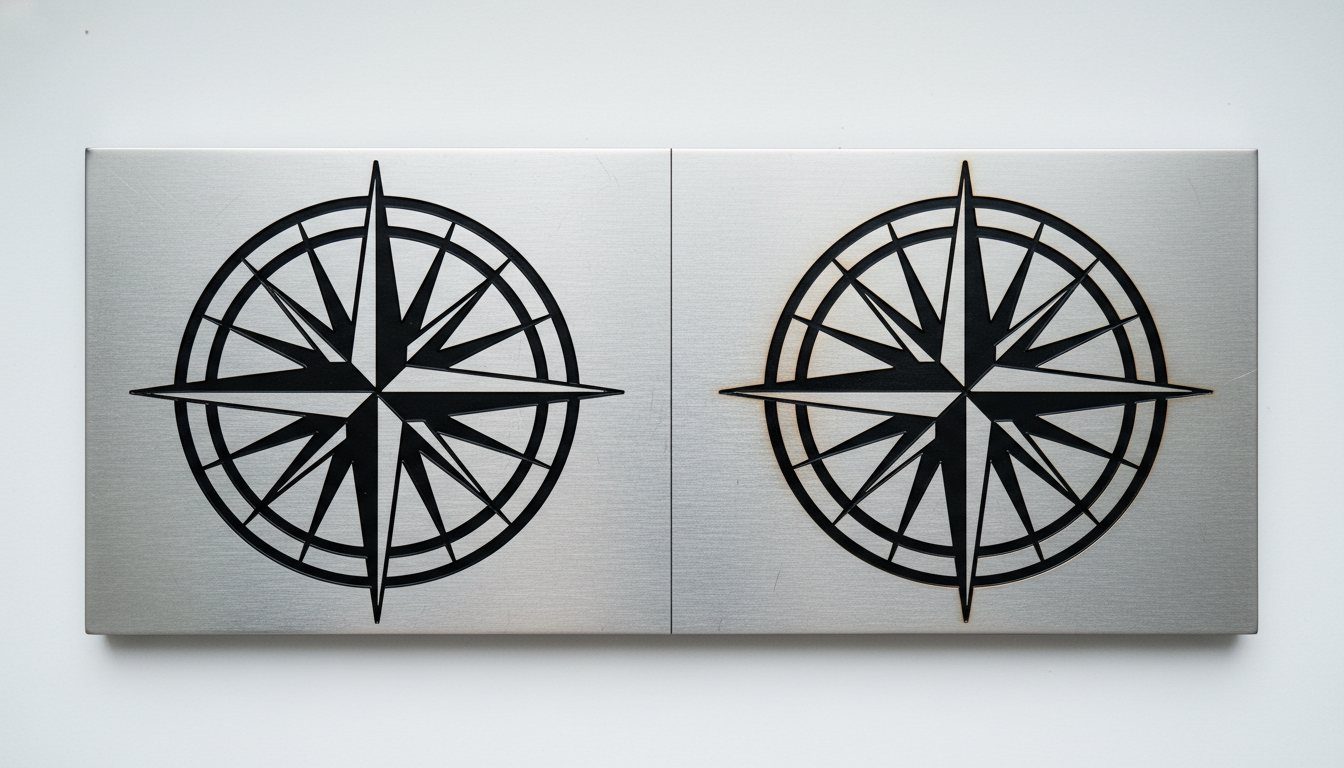
The short version: for durable marking on metal, laser is faster, finer, and more permanent. For very deep relief in soft metal, rotary still has a place.
Traditional engraving is mechanical: a spinning carbide or diamond bit cuts material as it traces the design. The bit has to press into the workpiece, which limits fine detail, how hard a metal it can work, and how delicate a part it can hold without deforming.
Laser engraving is thermal: a focused beam either ablates material (a cut-in engrave) or grows a thin surface oxide (a flush anneal or color mark). Nothing touches the part, nothing wears out mid-job, and the beam turns corners far tighter than any bit.
How they compare.
| Laser | Rotary / traditional | |
|---|---|---|
| Contact | None — beam only | Physical bit presses into the part |
| Fine detail | Excellent — photos, tiny fonts, QR codes | Limited by bit width |
| Hard metals | Titanium, hardened & tool steel — no problem | Hard on bits; slow or impractical |
| Delicate / irregular parts | Safe — no force applied | Risk of slipping or deforming the piece |
| Deep relief in soft metal | Possible, multi-pass, slower | Strong — a genuine advantage |
| Surface-flush marking | Yes — annealing, corrosion-safe | No — always removes material |
| Color on metal | Yes — MOPA oxide color marking | No (paint-fill only) |
Want the detail on what a laser can do per material, and where annealing beats a cut-in engrave? See the laser engraving capabilities, or read up on color marking and annealing.
Quick answers.
Is laser more permanent?
Both alter the material itself, so neither rubs off. Laser annealing has the edge outdoors — it leaves stainless's corrosion-resistant surface intact.
When is rotary better?
Very deep relief in soft metals, large trophy lettering, and some acrylic and signage work. For hard metals and fine detail, laser wins.
Which is right for my job?
Send a photo and a sentence. If laser's the wrong tool for the piece, expect a straight answer — and a pointer to the right one.
Get in touch.
Share the piece and the goal for a recommended method and a quote — free.